
Mesa is aggressively courting downtown hotels, restaurants, and nightlife because the city faces a genuine fiscal crisis. City Manager Scott Butler put the shortfall at roughly $30 to $36 million a year. Unlike most Valley cities, Mesa cannot raise its sales tax rate without a voter referendum. That constraint makes every tourist dollar, every hotel stay, and every downtown dinner check feel like a lifeline.
Your city is running short, and your spending habits are the proposed fix
If you live in Mesa, you are already feeling this squeeze indirectly. The city levies no primary property tax. Mesa and Gilbert are the only two Valley cities without one. That means Mesa lives and dies by its sales tax.
Budget Director Brian Ritschel said publicly at a March 2026 budget study session: “The past three fiscal years, our sales tax revenue has been flat.” The numbers back him up: $330 million in FY2023, $329 million in FY2024, $331 million in FY2025. The state projected just 0.4% growth for FY2025-26.
Meanwhile, the city lost ground on multiple fronts. The state repealed the residential rental tax, costing Mesa about $20 million a year. A new flat state income tax cut roughly $6 million more each year. San Tan Valley’s incorporation shrank Mesa’s share of shared state revenue by about $3 million a year. Those three hits together account for most of the $30 to $36 million hole Butler described.
Mayor Mark Freeman has made the constraint plain: “Some councils can raise a city sales tax at the dais. Our charter dictates that we must go to the voters for any city sales tax.” That is not a quick fix. So the city is pursuing the slower play. It is trying to attract more people to spend money here. More spending raises sales tax collections without raising the rate.
Mesa’s sales tax revenue per capita already sits at $645. That is the third lowest among Valley comparison cities. The Valley median is $853. Without a primary property tax to lean on, the city’s own Office of Management and Budget says that gap leaves Mesa “further below other cities.”
Two new hotels, four new restaurants, and a speakeasy: what actually opened
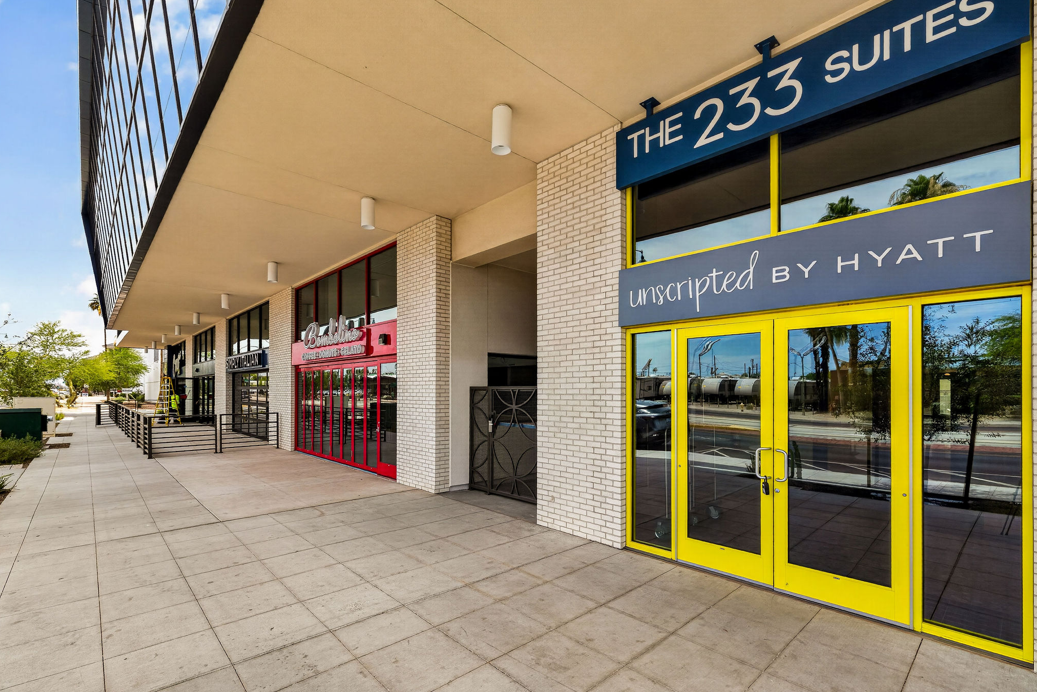
The 233 Suites (Unscripted by Hyatt) opened at 233 E. Main St. in downtown Mesa in early August 2026, bringing with it Crust Simply Italian, Bombolino’s Cafe, and The Nightingale speakeasy. (InsideTheValley.com)
The most visible piece of this strategy opened in early August 2026. The 233 Suites is a 76-room boutique hotel operating under the Unscripted by Hyatt brand. It opened at 233 E. Main St. in downtown Mesa. The project also includes Crust Simply Italian, Bombolino’s Cafe, The Nightingale speakeasy, and 13,000 square feet of new office space.
Mayor Freeman said at the ribbon-cutting that “every new hotel room supports local restaurants, shops, entertainment venues and jobs.” That is the theory. If visitors stay overnight, they eat dinner here, drink here, and shop here — generating sales tax dollars Mesa would otherwise never see.
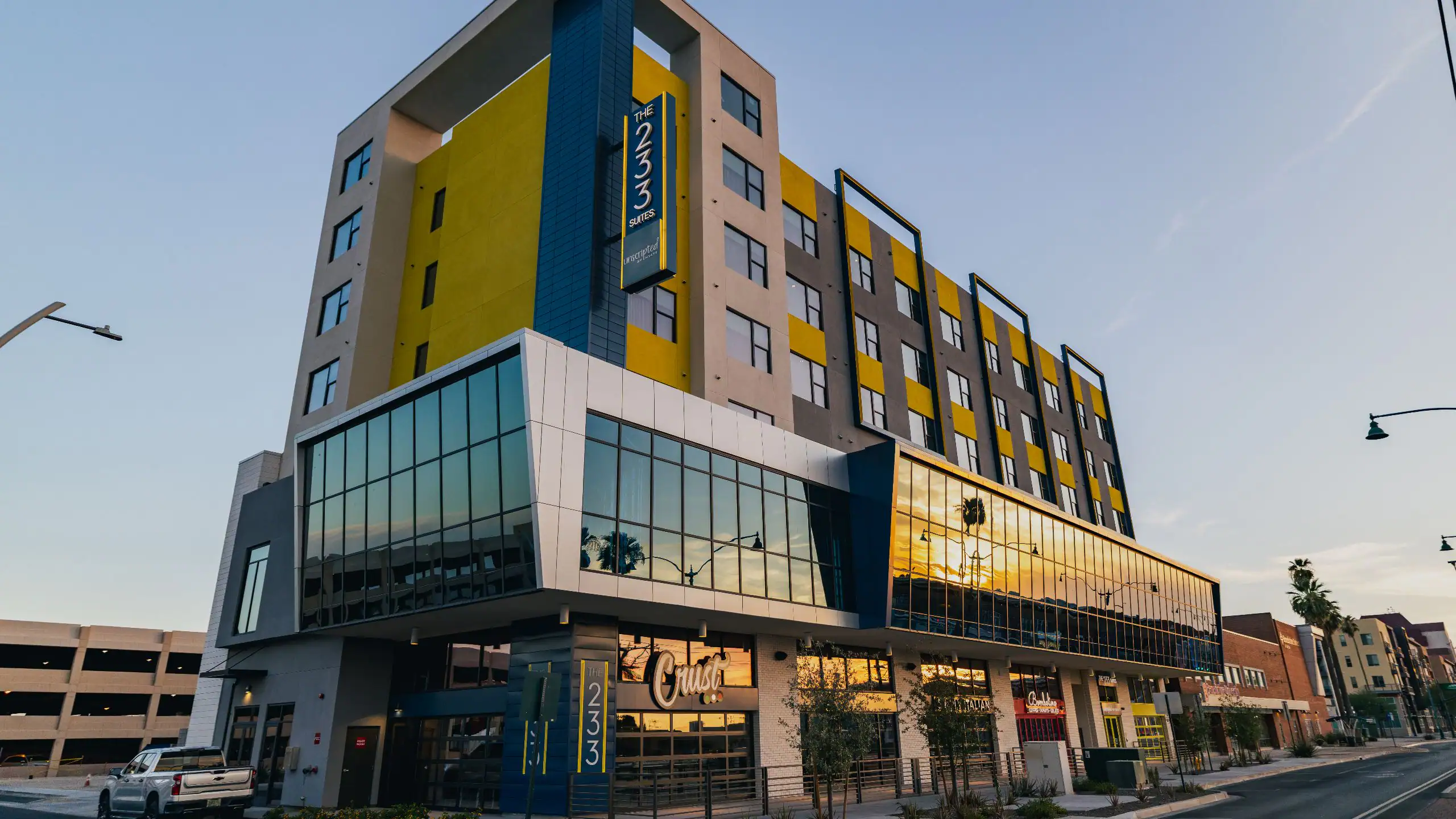
The 233 Suites at dusk, with Crust Simply Italian visible at street level. The project also includes 13,000 square feet of new office space. (InsideTheValley.com)
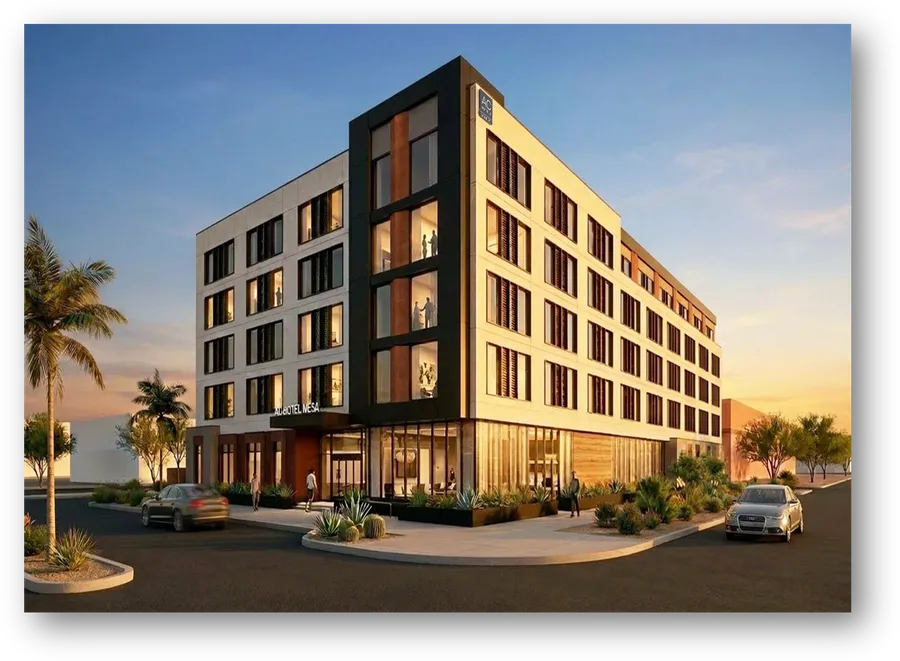
Then, on Aug. 10, the Mesa City Council unanimously approved a development deal for the second hotel. It is a five-story, 150-room AC Hotel by Marriott. It is planned for the northeast corner of Main Street and Centennial Way.
The AC Hotel deal: what the city gave up and what it expects back
The AC Hotel deal has specific financial terms worth knowing. The developer gets an eight-year GPLET. GPLET stands for Government Property Lease Excise Tax. Under this structure, the hotel is exempt from an estimated $2.1 million in property taxes over that period. The city will also reimburse up to $288,000 in construction sales taxes.
That reimbursement figure was revised upward from $226,000. The earlier amount appeared in the June 8, 2026 study session staff presentation. The final agreements were approved July 27 and ratified Aug. 10, with the cap set at $288,000.
In return, the developer licenses 100 parking spaces in a city garage. That generates roughly $5 million in parking revenue to the city over 50 years. The hotel is projected to produce about 45,000 room nights per year. It is also expected to generate approximately $500,000 annually in transaction privilege tax and transient lodging tax for Mesa.
Applied Economics prepared a report cited at the June 8 council study session. It projected $51 million in total indirect economic benefit to Mesa over the GPLET period. That breaks down as $31 million from visitor spending and $20 million from labor income.
Visit Mesa, the city’s tourism bureau, reports that total tourism generated a $1.2 billion economic impact in Mesa in 2024. It also produced $84.7 million in combined state and local tax revenue that year. Hotel rentals alone brought in more than $475 million in gross revenue over the prior three years. They also generated $33.3 million in tax revenues to the city over that same period.
Three hundred twenty-five million dollars in — but can the city prove it’s working?
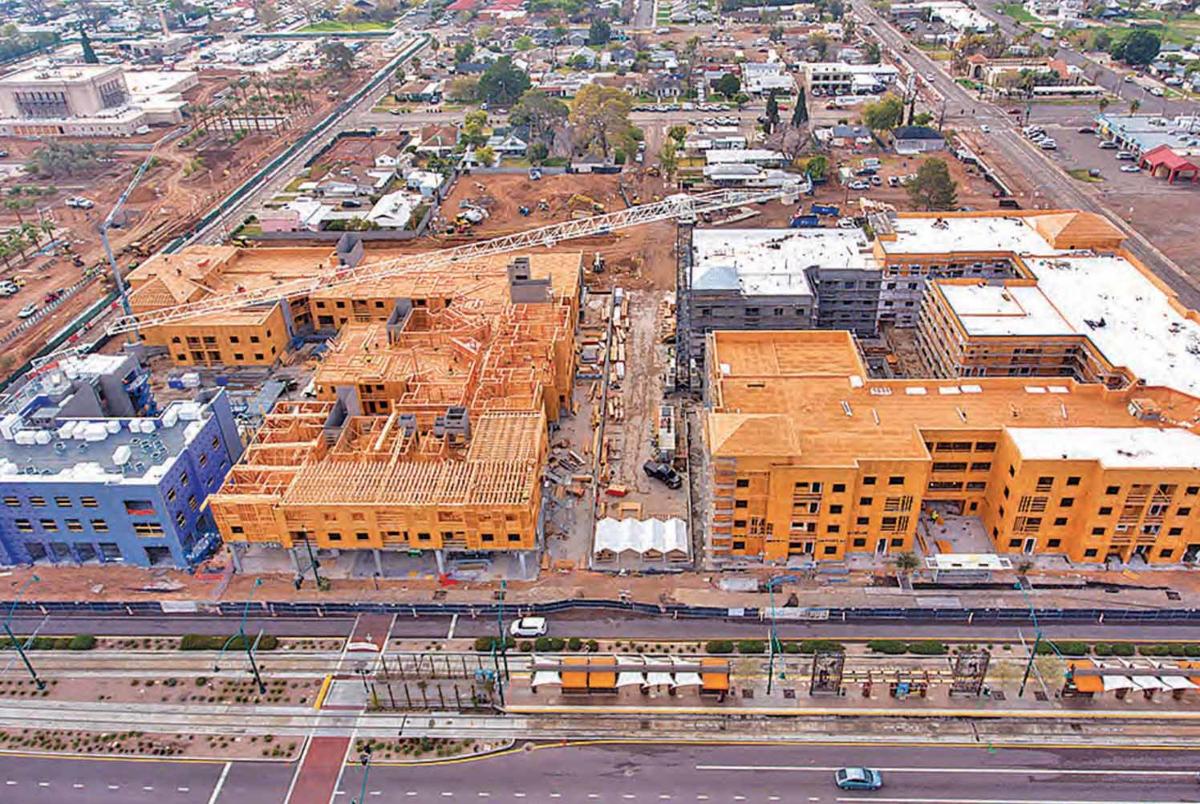
Active construction on multiple downtown Mesa projects, photographed from the air. Six projects remain in progress as of late 2026. (InsideTheValley.com)
Since ASU’s downtown MIX Center was announced in 2018, private investment in downtown Mesa has included 10 completed projects worth nearly $325 million. Six more are in progress. Those include the 1,000-unit Culdesac development, the 423-unit Edge on Main, and the AC Hotel by Marriott.
The city is also directing staff to negotiate a lease and cost-sharing deal with ASU. The plan is to expand its downtown creative-technology building at the city-owned post office site. That project is estimated at over $25 million to $30 million — a significant public investment layered on top of an already stressed budget.
Yet the accountability question hangs over all of it. City councilmembers have pressed staff on whether the city is tracking return on investment. Officials have acknowledged they cannot prove downtown development directly generates the sales tax dollars needed to close the budget gap. The sales tax numbers — flat for three years — make that admission harder to wave away.
A specialist fiscal analysis noted that Mesa has not published a study demonstrating the AC Hotel would not be built without city incentives. That is the standard “but-for” test for any tax subsidy. Without it, residents are largely taking the city’s word that the deal is worth it.
Downtown transformation manager Jeff McVay said leaders want to continue building a “FULL downtown experience,” with everyday amenities that make living downtown as convenient as visiting it. The goal is not just tourists. It is year-round residents spending money locally instead of driving to Tempe or Scottsdale.
When the next milestones land, and what they will reveal
The AC Hotel by Marriott has council approval. Its groundbreaking and eventual opening are the next visible markers. No opening date has been published yet. The Culdesac and Edge on Main developments are in progress, with no announced completion dates in the available record.
The bigger test is simpler to describe and harder to answer. Will Mesa’s sales tax collections finally break out of the $329 to $331 million range? If they do, the city will point to downtown. If they stay flat even as hotels open and restaurants fill, the accountability questions will get louder. A voter referendum on the sales tax rate may eventually become unavoidable.
For Mesa residents, the near-term upside is real: more places to eat, drink, and stay close to home without driving to Tempe or Scottsdale. The long-term question is whether that activity generates enough tax revenue to stabilize a city budget that is currently losing ground.