
Amazon drone delivery is already live in the Phoenix metro, launched in Tolleson in November 2024. Walmart and Wing are targeting Phoenix for 2027. A third operator, Zipline, named Phoenix one of its first two major U.S. expansion cities. Three companies are now racing to cover the Valley — and the competition is moving faster than the safety record or the regulation.
If you live in the West Valley, drones are already flying over your neighborhood
Amazon’s Tolleson hub covers roughly 175 square miles. If your home falls inside that radius, you can already order from more than 50,000 eligible items and have them at your door in under an hour. That footprint will grow. Amazon announced on August 19, 2026 that Prime Air will expand from 11 U.S. locations to nearly 500 cities and towns by the end of 2026.
You don’t have to opt in to be overflown. Amazon’s MK30 drone cruises at 205 to 250 feet above ground and drops to 14 feet to release a package — roughly the height of a two-story roofline. Wing’s drone lowers packages by tether to a yard or driveway. Neither requires your permission to pass over your property.
If you are bothered by the noise or the cameras on board, your city council cannot help you. The FAA holds exclusive authority over navigable airspace. Phoenix, Maricopa, and every other Valley municipality is barred from restricting flight paths by local ordinance. Your only recourse is the FAA directly, or through Congress.
For residents who want the service, the pitch is real. Wing’s communications manager, Jessie Poole-Strang, cited Phoenix’s traffic and summer heat as reasons drone delivery fits the Valley well. A 30-minute grocery drop to your driveway in July is a different value proposition than it is in Seattle.
Phoenix is already drone country: Amazon’s Tolleson hub explained
Amazon opened its Tolleson facility in November 2024. It is the company’s first fully integrated hybrid site — part fulfillment center, part delivery station — meaning drones launch and land from the same building where orders are picked and packed. No separate logistics hop needed.
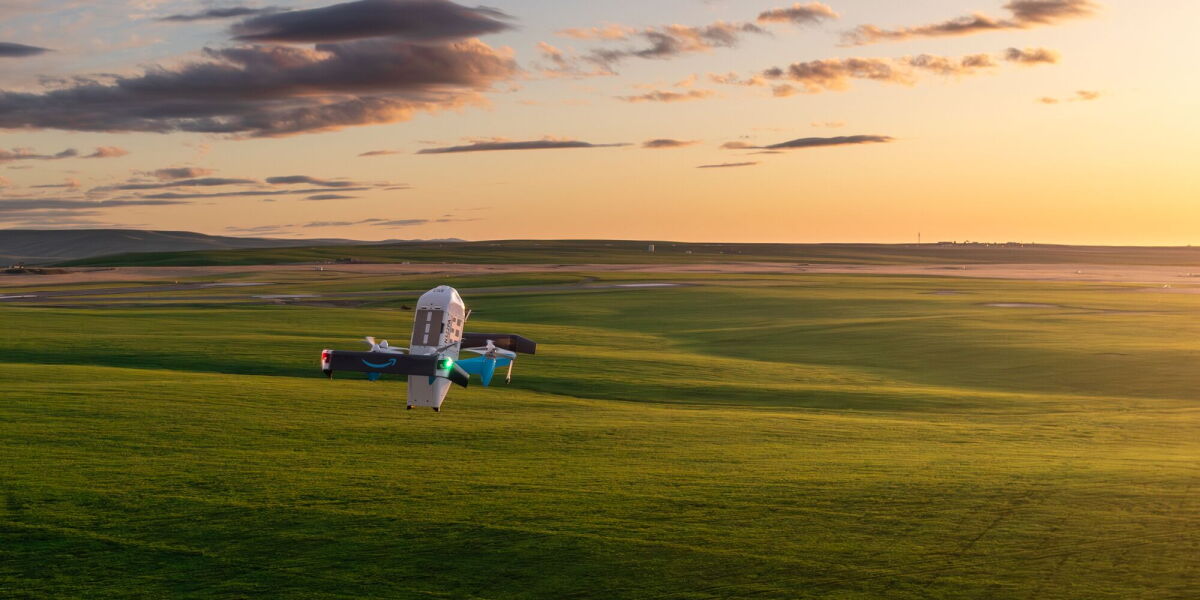
An Amazon MK30 drone hovers at low altitude during a delivery operation. The MK30 has a 5.5-foot wingspan and cruises at 205–250 feet above ground. (Amazon Prime Air)
The MK30 drone stands about 5 feet tall, has a 5.5-foot wingspan, and flies up to 74 mph. It descends to 14 feet to drop a package. Amazon’s own engineering data says the MK30 is roughly 50 percent quieter than prior models, and an FAA environmental review found its noise levels well below the FAA’s 65-decibel threshold for noise-compatible land use.
Prime members pay $2.99 per delivery on orders under $50, and nothing on orders over $50. Non-members pay $4.99. Eligible items must weigh 5 pounds or less.
The Tolleson crane crash, the open NTSB investigation, and the expansion anyway
On October 2, 2025, two Amazon MK30 drones collided with the boom of a stationary construction crane near Roosevelt Street and 97th Avenue in Tolleson. One drone caught fire. Both were listed as sustaining substantial damage in the FAA preliminary report. The FAA and the NTSB both opened investigations.
Amazon resumed deliveries within days. The NTSB investigation was still open when Amazon announced its 500-city expansion on August 19, 2026. Amazon Prime Air VP David Carbon projected 1 million drone deliveries in 2026 on that same call. The company has not publicly addressed the tension between that timeline and the unresolved crash review.
Amazon vs. Walmart/Wing vs. Zipline: a side-by-side for Valley residents
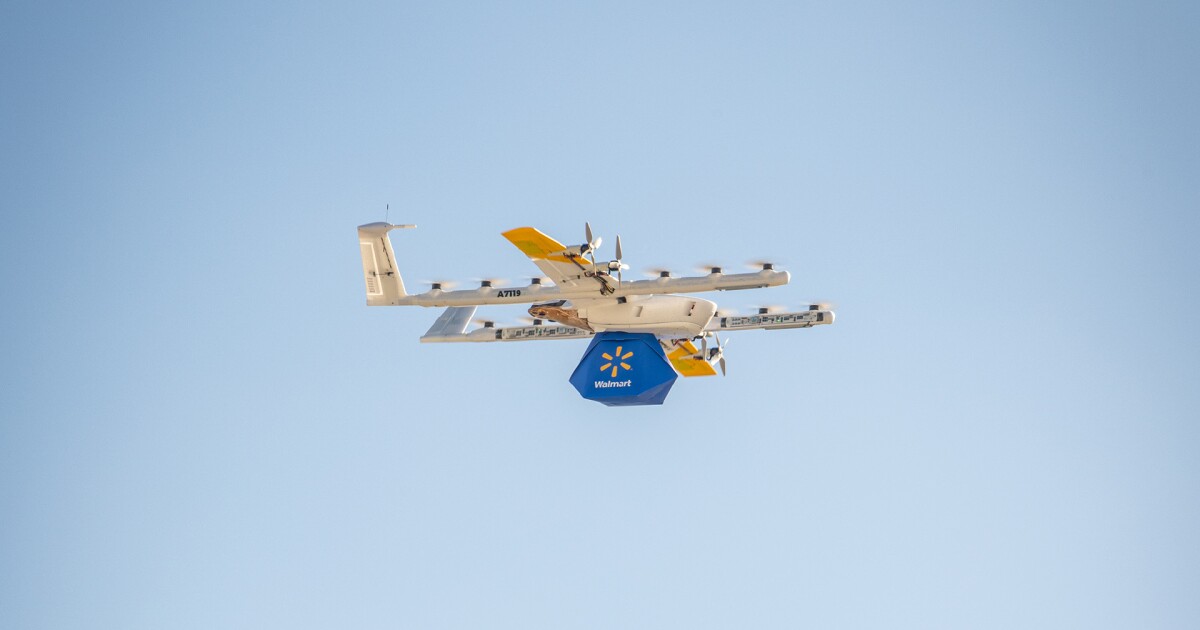
A Wing drone carries a Walmart-branded package. Wing drones travel up to 60 mph and lower packages by tether. (Wing/Walmart)
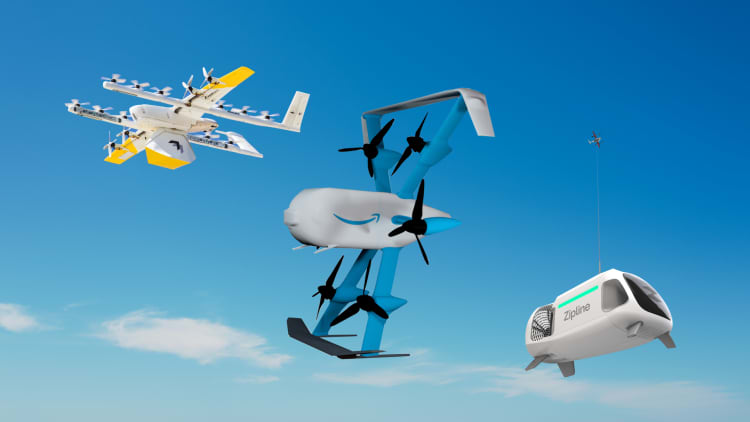
Amazon is live now in Tolleson. Its MK30 tops out at 74 mph and handles items up to 5 pounds. Coverage is roughly 175 square miles per site.
Walmart and Wing are targeting Phoenix by 2027. Wing drones top out at 60 mph. They use a tether to lower packages to a yard or driveway rather than dropping them. The system is aimed at groceries and household essentials.
Zipline is the newest entrant. It named Phoenix one of its first two major U.S. metro expansions in January 2026, backed by a $600 million funding round that valued the company at $7.6 billion. Its P2 Zip drone carries up to 8 pounds — more than either rival — within a 10-mile service radius. It hovers at about 300 feet and lowers a self-steering tethered capsule that can land within half a meter of a target. Zipline demonstrated its system at Arizona State University’s Research Park and was working with the FAA and Valley cities toward a mid-2026 launch as of April 2026.
The Maricopa Walmart parking lot that could become a drone hub
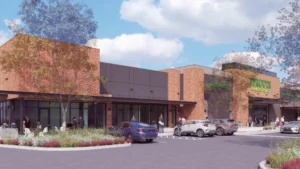
Wing’s planned Phoenix-area infrastructure follows a different model than Amazon’s. Instead of a standalone fulfillment center, Wing launches from Walmart store parking lots. In Maricopa, a proposed Wing hub would occupy a fenced section of the Walmart parking lot at Maricopa-Casa Grande Highway and Porter Road.
As of late June 2026, that project was still in the pre-application phase. No launch date has been confirmed for Maricopa specifically. Nationwide, Walmart and Wing are targeting 150 store locations online by the end of 2026 and 270-plus by 2027, with the goal of reaching more than 40 million Americans.
What drone delivery infrastructure means for Phoenix commercial real estate

Phoenix’s urban core at dusk. Drone delivery infrastructure is reshaping last-mile logistics across the metro. (Phoenix, Arizona)
Amazon’s model keeps logistics inside existing fulfillment buildings. That limits new industrial leasing in the short term, but it also signals that hybrid fulfillment — not traditional retail — is where suburban industrial demand is heading. Landlords near Amazon’s logistics corridor in the West Valley are already watching that closely.
Walmart’s model converts parking lots into drone launchpads. That is a different kind of asset use — one that repurposes retail square footage rather than replacing it. For Valley commercial brokers, a Walmart store with a Wing hub is a more defensible retail anchor than one without. It is also a data point on where last-mile logistics infrastructure is being built: inside existing retail footprints, not in new warehouses.
On the residential side, no study has yet quantified the effect of drone flight corridors on home values. That remains an open question. What is documented: in Richardson, Texas, one resident logged 122 drone overflights above her home in a single 10-hour day. Persistent overflight of that frequency, if it becomes normal in Phoenix neighborhoods, is the kind of quality-of-life issue that shows up in buyer conversations — even if it does not yet show up in price data.
When the next milestones actually land — and what is still unknown
Amazon’s 500-city expansion was announced for completion by the end of 2026. Which specific Phoenix-area ZIP codes come online beyond Tolleson’s current 175-square-mile radius has not been disclosed. You can check eligibility through the Amazon app by entering your address at checkout for a Prime Air-eligible item.
Walmart and Wing have confirmed Phoenix as a 2027 target metro. The Maricopa parking-lot hub at Maricopa-Casa Grande Highway and Porter Road is in pre-application as of late June 2026; no approval or launch date has been set.
Zipline targeted a Valleywide mid-2026 launch as of April 2026. Whether that timeline held has not been confirmed in published reporting as of this writing.
The NTSB investigation into the October 2025 Tolleson crane crash has no published closure date. Until that report is final, the safety record of the Valley’s only active drone hub remains officially open.