
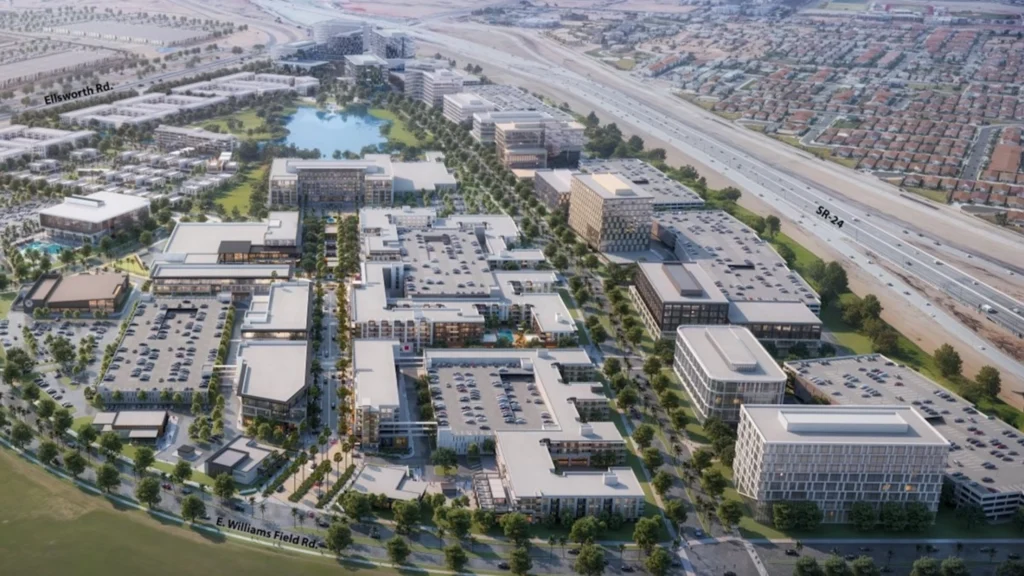
Mesa City Council unanimously approved Legacy Park and Gateway Crossing on September 14, 2026. The roughly $3 billion mixed-use development is the largest private investment in Mesa’s history. It will bring resort hotels, offices, apartments, restaurants, and a public lake park to southeast Mesa, near Mesa Gateway Airport.
If you live in southeast Mesa, here is what just changed
Right now, southeast Valley residents drive to Scottsdale or Tempe for destination dining and hotels. Legacy Park is designed to fix that. But the first phase does not open until October 2029, so your daily life stays the same for about three more years.
The 20-acre public park with a lake will be free to residents. The resort and hotels are aimed at visitors who already fill Arizona Athletic Grounds and Mesa Gateway Airport. That means fewer guests hunting for distant rooms on event nights. The 13,500-plus projected jobs could also shorten commutes now aimed at Downtown Phoenix.
For Eastmark homeowners, proximity to a destination project tends to support home values. More local amenities and stronger community identity usually lift buyer demand. The offset risk is added traffic on Ellsworth Road and Williams Field Road. The net effect on any individual address depends on how fast each phase builds and how well Mesa manages nearby roads. If you are buying near the Gateway area, this approval is worth factoring in. You can also read about the Eastmark Aquatic Complex and the new Sprouts Eastmark for more context on what is coming to this part of Mesa.
Citywide, the new sales and lodging tax revenue feeds Mesa’s general fund. Arizona eliminated municipal residential rental taxes on January 1, 2025. The League of Arizona Cities and Towns estimated that change costs municipalities about $230 million a year statewide. Landing a high-sales-tax destination project is one way Mesa starts replacing that lost revenue.
What is Legacy Park, and what exactly did Mesa approve?
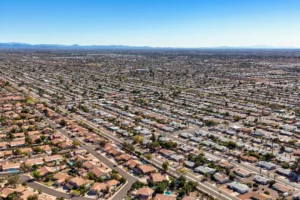
Legacy Park sits on about 200 acres east of Ellsworth Road, between State Route 24 and Williams Field Road. It is in southeast Mesa, just north of Arizona Athletic Grounds, near Mesa Gateway Airport. Phoenix-based developer Vestar is the master developer. David Larcher, Vestar’s president and CEO, told the council this is “a generational project that can really define a community’s identity.”
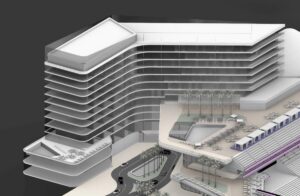
At full build-out, plans include roughly 400,000 square feet of restaurant, retail, and fitness space. There is also a 600-room luxury resort, 3.8 million square feet of office space, 2,261 apartments, a 150-room boutique hotel, and a 20-acre city park. The September 14 approval was a five-action package in one council session. It covered a development agreement, a retail tax incentive agreement, an annexation ordinance, a zoning ordinance, and the creation of a theme park district.
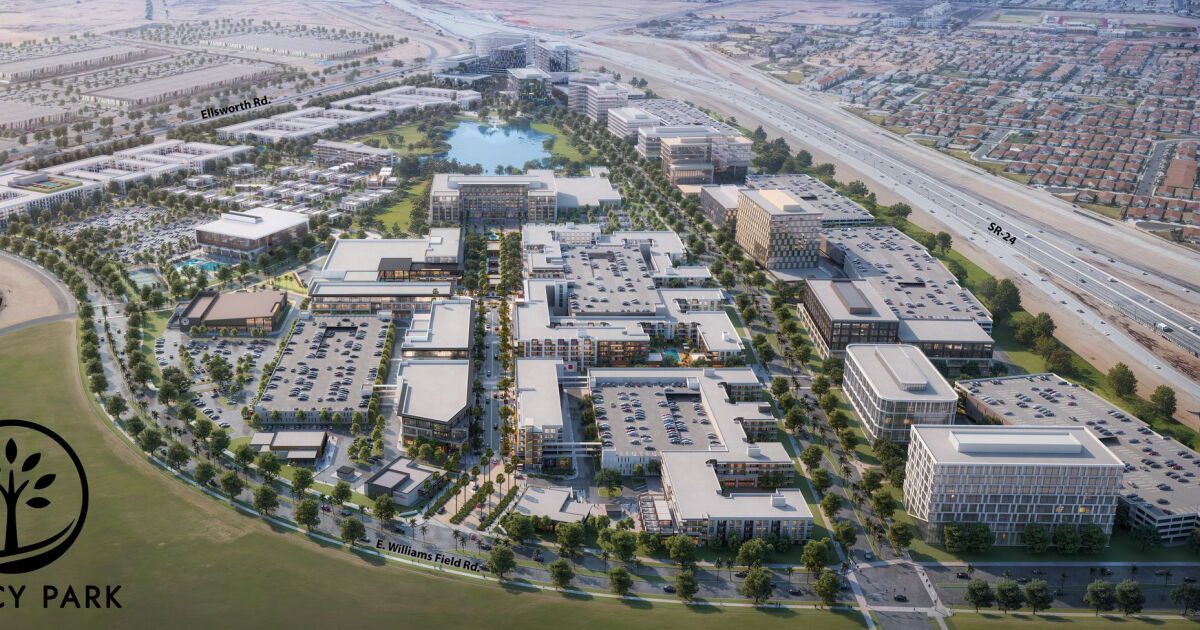
An aerial rendering of Legacy Park shows the project layout along Ellsworth Road, Williams Field Road, and SR-24, with a central lake, commercial buildings, residential blocks, and green corridors. (Vestar / City of Mesa)
Gateway Crossing: the forty-acre project across the street
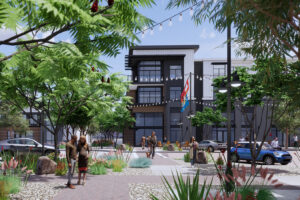
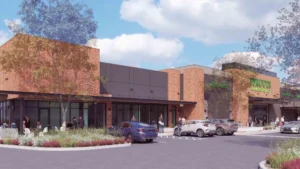
Gateway Crossing is a separate companion project. It sits on about 40 acres directly across Williams Field Road from Legacy Park. The site was formerly planned as Legacy Towne Center. Vestar is the developer here too. A pedestrian tunnel will connect the two projects and link them to Arizona Athletic Grounds. Gateway Crossing focuses on street-level retail and dining facing Williams Field Road. Legacy Park is the larger campus behind it.
Phase 1 timeline: every milestone from groundbreak to opening
Vestar plans to break ground on public infrastructure in January 2028. Vertical construction begins in June 2028. The first phase opens in October 2029. Phase 1 costs $1 billion on its own. Full build-out of the entire roughly $3 billion project will take longer. No final completion date has been announced.
How the tax deal works — and what it costs Mesa
Vestar pays for all infrastructure upfront. Mesa does not cut a check before the project is open and generating revenue. The city repays Vestar over time using a share of sales and lodging taxes collected on-site. Total reimbursements are capped at $76.4 million. Once that cap is hit, all remaining tax revenue from the site flows fully into Mesa’s general fund.
The theme park district created alongside this approval operates under Arizona Revised Statutes Title 48, Chapter 36. Property the district builds is exempt from state and local property taxes. The district can also issue revenue bonds for theme park purposes. That category includes entertainment, lodging, and related infrastructure.
An independent analysis by Applied Economics projects about $58.8 billion in total economic activity over 30 years. It also projects more than 13,500 jobs and $1.4 billion in City of Mesa tax revenue. Those figures come from a third-party consultant and carry the uncertainty that long-range economic models always carry.
Why Vestar cannot use Mesa’s tap water for the lake
Mesa bans using city water to fill bodies of water larger than 12,320 square feet inside the Phoenix Active Management Area. That rule comes from Arizona Revised Statutes §45-132. The Legacy Park lake would far exceed that limit.
The legal path around it is ARS §45-133. A developer in this situation may use groundwater drawn from a Type 2 non-irrigation grandfathered right. They need an interim water use permit from the Arizona Department of Water Resources director. They must also show that enough effluent will be available within five years.
Type 2 rights are based on historical industrial pumping between 1975 and 1980. They can be sold separately from the land where they originated. That means Vestar can buy rights from a closed industrial site rather than pull new water. The former GM proving ground history of this site matters here. GM ran heavy industrial operations on the property for decades. Sites like that often carry exactly the pumping record that generates Type 2 rights.
Vestar must also build a fully separate pipe system at its own cost. No connection to Mesa’s municipal water infrastructure is allowed. It is a significant engineering hurdle and the bill falls entirely on the developer.
Who owns the land: Pacific Proving LLC and the former GM proving ground
General Motors opened a Desert Proving Ground near Ellsworth and Pecos roads in southeast Mesa in 1953. GM used it to test HVAC, propulsion, and other vehicle systems in desert heat. GM vacated and relocated to Yuma in 2009.
Pacific Proving LLC — led by Andrew Cohn and Bill Levine — purchased roughly 1,800 acres of that site in 2004 for $45 million. The entity has been selling parcels to industrial and tech users ever since. In 2024, it sold 87 acres to DSV Air & Sea for $46 million. It also sold 173 acres to NTT Data Group. Cohn and Levine held the core acreage for more than twenty years before the Vestar deal came together. Pacific Proving and its affiliate Mesa BA Land LLC both trace to Levine Investments and Andrew Cohn. Their full land position in Mesa’s East Valley totals 1,805 acres.
The name confusion: Legacy Park and Arizona Athletic Grounds are two completely separate stories
If you search “Legacy Park Mesa” and find headlines about prison sentences, those are about a different project. The original Legacy Park was a sports complex later renamed Bell Bank Park and now called Arizona Athletic Grounds. Its former operators, Randy Miller and Chad Miller, were sentenced to federal prison in September 2025. Randy received six years and Chad received five years. The charges involved a $284 million municipal bond fraud tied to that earlier project.
Vestar’s Legacy Park is a completely distinct development. Different land, different developer, different ownership, different approval process. The shared name caused confusion during public comments at the council hearing. The two projects have no legal or financial connection.
Groundbreak is roughly sixteen months away — here is what has to happen first
The September 14 council vote cleared the legal path. The development agreement is signed. The zoning is set. The tax incentive structure is in place. The theme park district exists. What comes next is on Vestar.
The developer must secure private Type 2 groundwater rights for the lake. It must design and permit the separate water system. It must complete construction drawings and line up financing for the $1 billion Phase 1 build. The January 2028 infrastructure groundbreak is the next public milestone to watch. If that date slips, it is the first real signal of timeline pressure. The October 2029 Phase 1 opening follows about twenty-two months after that groundbreak.
For more on what is happening around the Gateway area, see our coverage of the Destination at Gateway annexation and The Nox concert venue in Mesa.