
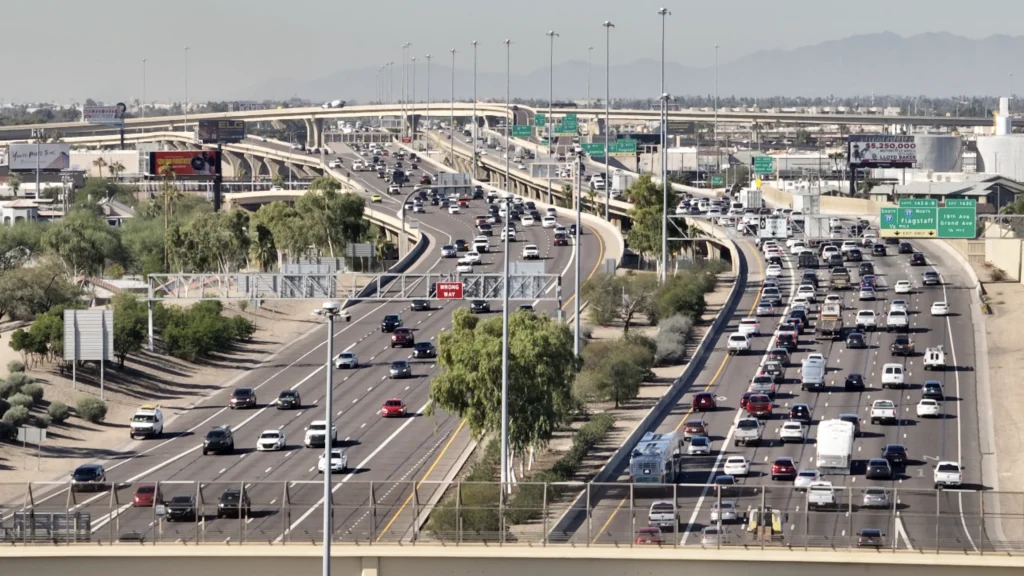
Phoenix-area freeways have no scheduled closures this Thanksgiving weekend. ADOT and its contractors paused all highway construction from Wednesday afternoon, Nov. 25 through late Monday night, Nov. 30. That sounds like good news — and it is — but ADOT is still warning drivers to expect heavy traffic and possible delays on I-17 north of Phoenix and on I-10 in both directions.
Your drive is going to be slow regardless — here is why
Normally, construction zones are the main reason Thanksgiving trips slow down. This year ADOT removed that variable entirely. No lane closures, no barrels, no merge points. And yet the agency published an explicit warning about delays anyway.
The reason is straightforward: about 1.7 million Arizonans are traveling over the six-day holiday period, and roughly 1.5 million of them are driving. That is a slight increase over last year. Pure volume — not construction — is now the only bottleneck on Valley freeways.
If you are heading north on I-17 toward Flagstaff or Sedona, or south and west on I-10 toward Tucson or California, budget extra time even though you will not hit a work zone. The same applies if you are just running errands or picking up guests locally — surface streets and on-ramps will back up when freeway traffic thickens.
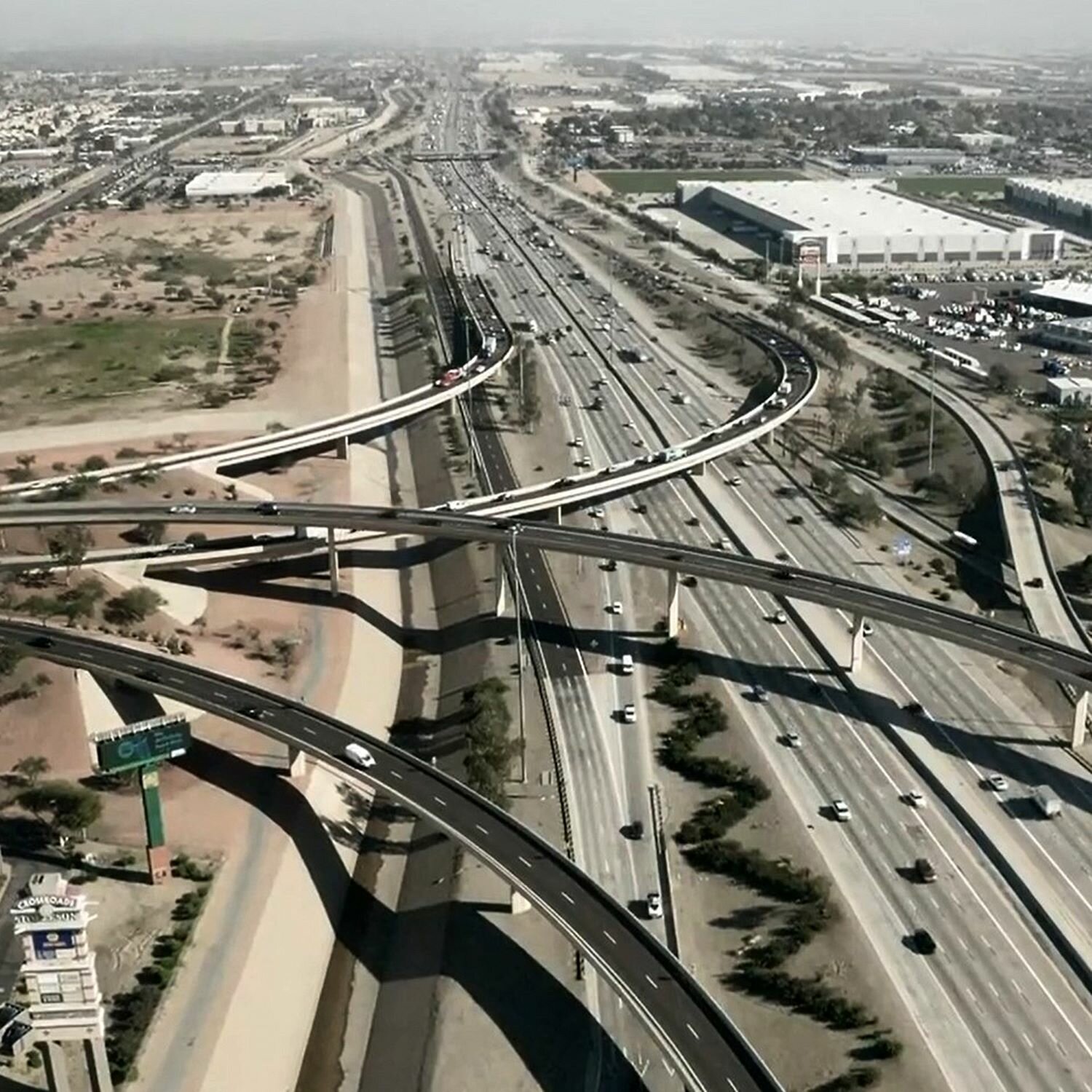
Aerial view of the Loop 101 and I-10 interchange in the Phoenix metro area. Both corridors are open but expected to carry heavy holiday volume throughout the weekend. (InsideTheValley.com)
When traffic will be worst: the specific windows to avoid
AAA and INRIX identified the peak congestion windows for the holiday period. Here is the full list:
- Tuesday, Nov. 25: 2 p.m. to 8 p.m.
- Wednesday, Nov. 26: noon to 7 p.m. — the single worst outbound window
- Thanksgiving Day itself sees minimal traffic
- Friday, Nov. 28: noon to 9 p.m.
- Saturday, Nov. 29: noon to 8 p.m.
- Sunday, Nov. 30: 2 p.m. to 7 p.m. — the worst return window
If you can leave Wednesday morning before noon or wait until after 7 p.m., you will miss the worst of the outbound surge. For the return trip, arriving back in the Valley before 2 p.m. on Sunday, or pushing it to Monday, gives you the clearest roads.
Route-by-route breakdown for Valley drivers
ADOT specifically called out several corridors as expected trouble spots.
I-17 north of Phoenix is the primary route to Flagstaff and Sedona and will see heavy two-way volume all weekend. The I-17 flex lanes — an 8-mile reversible two-lane system between Black Canyon City and Sunset Point Rest Area — will help manage that flow. The flex lanes run northbound through late Saturday, Nov. 28. They switch to southbound travel on Sunday, Nov. 29, and Monday, Nov. 30, to handle the return surge. These are Arizona’s first flex lanes, completed in December 2025.
I-10 will be congested both toward Tucson and toward the California state line. ADOT also flagged State Route 87 between Fountain Hills and Payson, US 93 between Wickenburg and Hoover Dam, and I-8 between the Phoenix area and California as busy corridors this weekend.
For more on ongoing I-10 work between Phoenix and Casa Grande, see our I-10 widening guide for the Wild Horse Pass corridor.
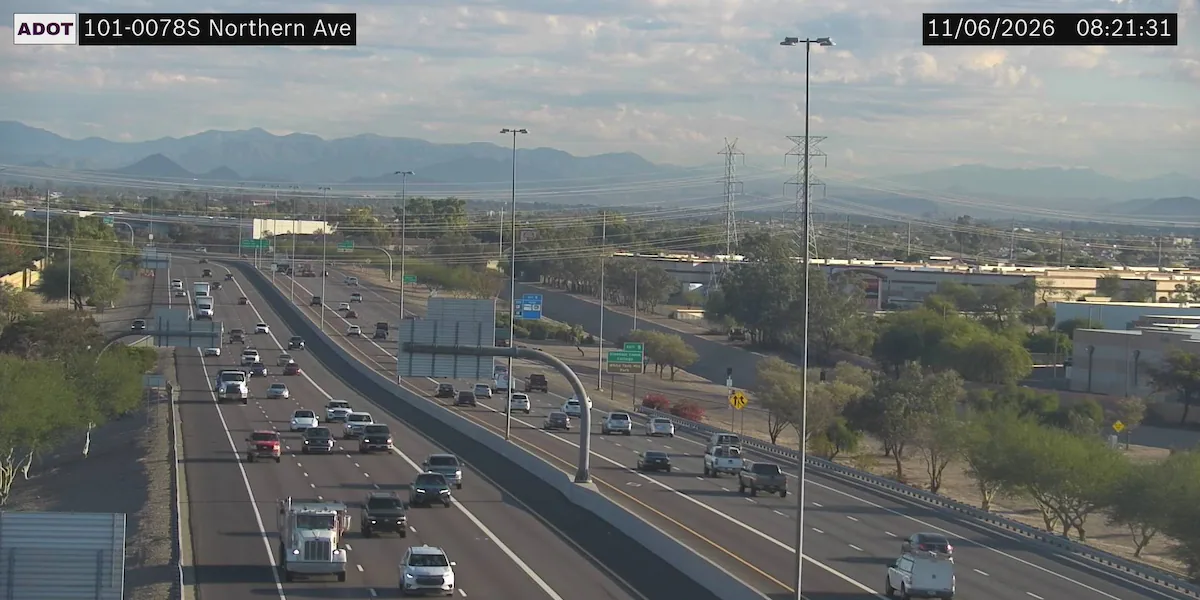
ADOT traffic camera on southbound Loop 101 near Northern Avenue. ADOT’s Incident Response Unit will patrol Phoenix-area freeways in Maricopa County from 4 a.m. to midnight on weekdays and 6 a.m. to 4 p.m. on weekends throughout the holiday period. (ADOT)
Scale of the holiday: what 1.7 million travelers means on Valley roads
AAA projects about 1.7 million Arizonans will travel during the six-day Thanksgiving period. That is a 0.4 percent increase over last year. Of those travelers, roughly 1.5 million will drive — up 0.2 percent year over year. More than 100,000 will fly, and about 137,000 will travel by bus, train, or cruise.
The AAA national holiday period runs Tuesday, Nov. 24 through Monday, Nov. 30. If you are flying out of Phoenix Sky Harbor, see our guide to new routes at Sky Harbor in 2026 and 2027 for terminal and airline details.
Gas prices this Thanksgiving: higher than last year, slightly lower than last week
Arizona’s statewide average for regular gas is around $3.88 to $3.90 a gallon. That is down about 15 cents from last week — a small but real saving at the pump. However, it is not cheaper than last year. KOLD reported on Nov. 25 that last year’s Arizona average was $3.06, meaning drivers are paying more than 80 cents a gallon more than they did at Thanksgiving 2025.
A full tank on a typical SUV will cost roughly $10 to $15 more than it did a year ago. Plan accordingly if your trip involves multiple fill-ups.
ADOT’s Incident Response Unit and how to stay informed
ADOT’s Incident Response Unit (IRU), sponsored by GEICO, will patrol Phoenix-area freeways in Maricopa County throughout the holiday period. On weekdays, crews run from 4 a.m. to midnight. On weekends, they run from 6 a.m. to 4 p.m. The IRU helps clear crashes and debris faster, which keeps volume-driven slowdowns from turning into full stops.
For real-time conditions, ADOT recommends checking az511.gov or calling 511 before you leave. ADOT also asks drivers to allow extra time and stay alert — especially during peak windows on I-17 and I-10.
For winter road conditions on mountain routes after the holiday, check our Arizona winter highway closures guide.
After Monday night, Nov. 30: when normal freeway work resumes
ADOT’s construction pause ends late Monday night, Nov. 30. Work on state highways, including ongoing projects across the Valley, can resume after that point. If you are driving back into Phoenix on Monday, aim to get home before the late-night window when crews may begin setting up again.
No future holiday pauses have been announced. ADOT publishes weekly freeway advisories at azdot.gov, and those will reflect any new closure schedules starting the week of Dec. 1.