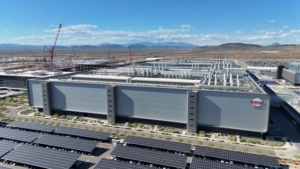


Arizona Rep. Greg Stanton called on President Trump to fire Commerce Secretary Howard Lutnick on Nov. 12. He accused Lutnick of letting advanced Nvidia chips reach China through a Singapore company called Megaspeed. The scandal has a direct Phoenix angle: TSMC’s north Phoenix campus is where Nvidia’s Blackwell chip wafers are made. Thousands of Valley jobs now sit inside a widening Washington political storm.
Your north Phoenix neighbors already work at the plant in the crosshairs
If you live near the north Phoenix freeways, you likely know someone who works at TSMC. The campus near 51st Avenue and Carefree Highway already employs about 3,500 people. Another 2,500 hires are planned as the expansion continues. These are high-skill, high-wage manufacturing jobs — the kind Arizona has chased for decades.
That campus is also where Nvidia’s Blackwell chip wafers are made. So when a Singapore company allegedly smuggles those chips into China, the story lands at your neighbor’s workplace. And when the cabinet secretary responsible for stopping that smuggling is under fire, the stakes get local fast.
The Commerce Department — the agency Lutnick leads — is also the agency that administers the CHIPS Act. TSMC’s Phoenix investment carries up to $6.6 billion in CHIPS Act direct funding. If Lutnick is fired or Commerce is weakened mid-execution, the management of that funding becomes an open question. No change to Phoenix operations has been reported, but the political volatility is real.
TSMC has committed more than $65 billion to its Phoenix site across three leading-edge fabs. In March 2025 the company announced an additional $100 billion in U.S. manufacturing investment, bringing its total U.S. commitment to roughly $165 billion. That includes three new fabs, two advanced packaging facilities, and an R&D center. All of it now rides on a stable policy environment — which is exactly what this week put in doubt.
Who is Megaspeed, and what did Lutnick fail to do?
Megaspeed is a Singapore-based company that U.S. officials suspected of helping China evade export bans on Nvidia’s most advanced AI chips. Stanton said the issue was on Lutnick’s radar for more than a year. Despite that, Megaspeed was never blacklisted.
Then Jensen Huang resigned as Nvidia CEO after reports surfaced of a personal relationship with Alice Huang, a Megaspeed executive U.S. officials suspected of being a Chinese spy. That resignation turned a trade-enforcement story into a full-blown corporate and national-security crisis.
Bessent’s broadside: four agencies versus one Commerce Department
Treasury Secretary Scott Bessent went on CNBC and said plainly that the Commerce Department failed to follow through on blacklisting Megaspeed. He said Treasury, State, Defense, and the U.S. Trade Representative all favored the move. Commerce alone blocked it.
That is a remarkable break. A sitting Treasury secretary publicly blamed a cabinet colleague by department — on live television — for a national-security lapse. It isolated Lutnick within the Trump administration in a way that is hard to walk back.
The White House contradiction: confidence statement, ouster talks
The White House issued a statement saying Trump “maintains complete confidence in the secretary.” At the same time, Trump advisers were reportedly discussing a possible Lutnick ouster. Both things were happening simultaneously, on Nov. 13.
That gap — public confidence, private discussion of removal — is exactly the kind of uncertainty that slows federal program execution. The CHIPS Act disbursements Lutnick oversees do not pause for political drama, but the people managing them do watch who is in charge.
Nvidia’s market meltdown, by the numbers
Nvidia shares fell to roughly $162 on Nov. 13. That is about a 30% drop from their Oct. 6 record high of $239.24. The stock posted a 13% weekly decline — its sixth straight losing week, the longest such streak since 2012 — erasing roughly $1.7 trillion in market cap.
Nvidia is TSMC’s most prominent customer for Blackwell wafers. When Nvidia’s market value collapses, it matters to everyone on that north Phoenix production floor.
Lutnick’s Senate testimony and what Congress wants to know
Lutnick has agreed to testify before the Senate Banking Committee. The specific date has not been announced in the sources available. Congress wants to understand why Megaspeed was never blacklisted. It also wants to know what Lutnick knew and when he knew it. That last point is exactly what Stanton flagged — he said the issue sat on Lutnick’s desk for more than a year.
Lutnick’s testimony date and what comes next for Arizona
The Senate Banking Committee hearing has not yet been scheduled publicly, based on available information. Three questions remain open. Will Lutnick keep his job? Who manages the CHIPS Act if he does not? And will the political noise slow the next phase of TSMC’s hiring ramp in north Phoenix?
None of that uncertainty has changed what is happening on the ground today. Construction continues. Workers report to shift. But Arizona’s largest manufacturing investment in a generation is now connected to a Washington fight that is not over. Residents who live near the TSMC campus — or who have family working there — have a reason to watch how this plays out.
For more on how TSMC’s growth is reshaping nearby neighborhoods, see our guide to TSMC Phoenix water use and north Phoenix resident impacts. We also cover the TSMC Phoenix real estate boom in north Phoenix suburbs. Nearby development tied to the chip campus is covered in our Halo Vista TSMC suppliers guide.