
ADOT is studying how to redesign the Mini-Stack interchange — where I-10, SR 51, and Loop 202 collide in central Phoenix — and it is holding two public meetings in early November 2026 to collect your input before the project moves into its environmental review phase. Your comments can directly influence which design options advance.
If you drive through central Phoenix, this affects your commute for years
The Mini-Stack interchange, rebuilt in 2004, now carries more than 300,000 vehicles a day. It is the busiest interchange in Arizona. If you use I-10, SR 51, or Loop 202 through central Phoenix — even occasionally — you have already felt what ADOT is trying to fix.
The corridor averaged more than five crashes a day between 2016 and 2021. That is not a rounding error. And ADOT projects that without improvements, peak-hour delays in the study area could climb by up to 60% by 2050. That means a bad commute today becomes a much worse one in less than 25 years.
No construction starts soon. A Draft Environmental Assessment public hearing is expected in late 2027 or early 2028. Construction follows that and will take several years. So the relief is real, but it is not close. What IS close is your chance to weigh in on what gets built. The comment periods tied to both November meetings last 30 days each.
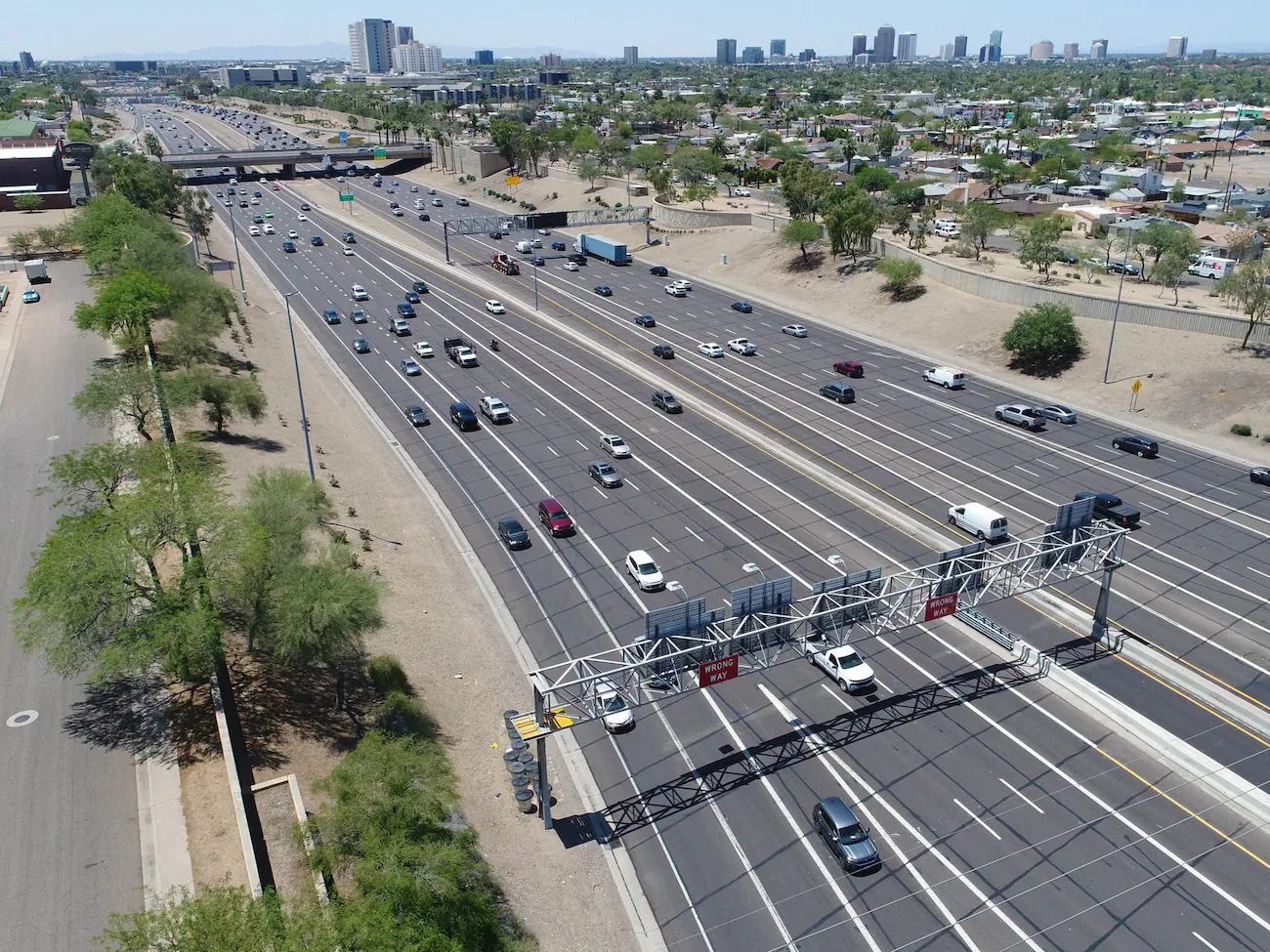
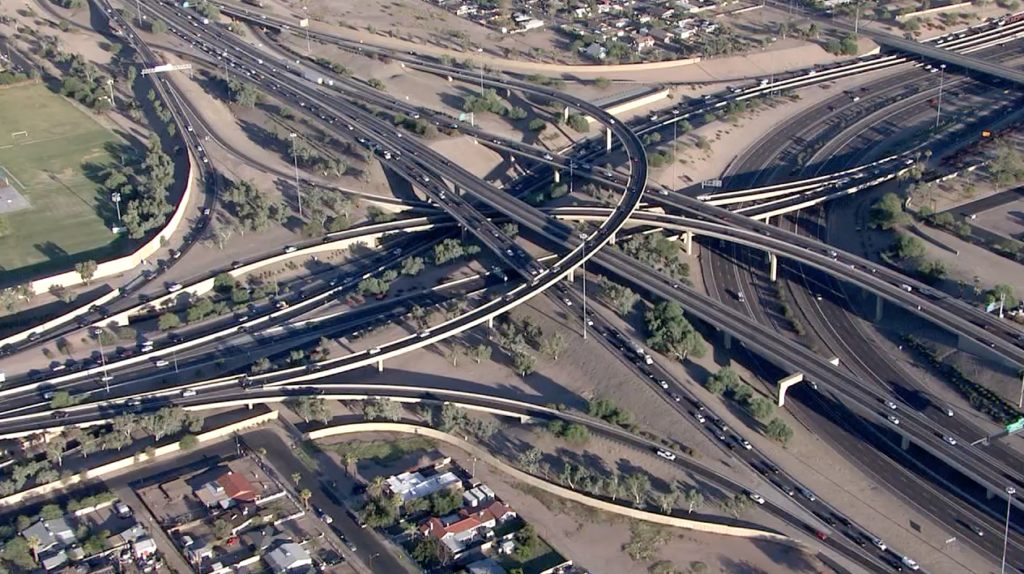
Heavy traffic stretches toward the Phoenix skyline along one of the central freeway corridors included in the ADOT study area. (InsideTheValley)
The study area: which freeways and roads are actually included
The study covers more ground than just the Mini-Stack itself. ADOT is looking at I-10 from the Deck Park Tunnel to the I-10/I-17 Split interchange near Sky Harbor, SR 51 south of Thomas Road, and Loop 202 west of 24th Street. All three converge at the Mini-Stack. If any of those segments are part of your regular route, you are inside the study boundary.
What ADOT is considering: lanes, ramps, and Broadway Curve-style roads
Three broad categories of design changes are on the table: collector-distributor roads similar to those at the Broadway Curve, additional through lanes, and new or relocated ramps.
The Broadway Curve comparison is worth understanding. At the Broadway Curve on I-10 between Baseline Road and 40th Street, ADOT built parallel roads — one in each direction — that run alongside the main freeway. Those roads carry drivers who are entering or exiting the freeway, so they never mix with through-traffic on the main lanes. The speed limit on those roads is 55 mph and there are no traffic signals. A similar setup at the Mini-Stack would physically separate weaving traffic from drivers just passing through — the root cause of many crashes and slow-downs there.
The no-build option: technically possible, practically unlikely
ADOT keeps a “do nothing” option on the table for any federally reviewed project. But the agency has signaled strongly that it would be very reluctant to leave the interchange unchanged. Given that the project already carries a funded line item in the state’s construction program, the no-build path is more of a legal formality than a real outcome.
How to attend: full details for both public meetings
You have two options in November 2026.
In-person — Thursday, Nov. 5, 2026: Doors open at 5:30 p.m. for an open house at Garfield Elementary School, 811 N. 13th Street, Phoenix, AZ 85006. A formal presentation starts at 6 p.m. The open house continues to 7 p.m. You can arrive any time in that window, review materials, and talk to ADOT staff.
Virtual — Monday, Nov. 9, 2026: The meeting runs from 6 to 7 p.m. Advance registration is required. Go to azdot.gov/I-10TunneltoSplit or use the direct Zoom link at bit.ly/I-10zoom to sign up. Spanish interpretation is available at both meetings.
Each meeting is followed by a 30-day public comment period. You can also submit comments directly through the study webpage at any time.
This project is already funded — not just a study
This is the detail most news coverage has missed. The Arizona State Transportation Board approved the 2027–2031 Five-Year Transportation Facilities Construction Program on June 19, 2026, at a board meeting in Nogales, Arizona. The total program is valued at $11.3 billion.
The Mini-Stack project is listed specifically as “I-10/SR 202L/SR 51 Mini Stack to SR 51 at Thomas Rd” with a programmed cost of $148,234,237. That is not a placeholder. That is a funded line item in an approved state program. The public meetings are about shaping the design of something that is already going to be built.
What this study builds on: the January 2025 MAG corridor study
ADOT’s current work did not start from scratch. The Maricopa Association of Governments published the I-10 Freeway Corridor Study — covering the Deck Park Tunnel to the I-10/I-17 Split — in January 2025. That study identified specific recommendations for improving safety and capacity. ADOT’s environmental study picks up where the MAG work left off and moves the recommendations toward a buildable design.
The November meetings, and what comes after them
After the November comment periods close, ADOT will continue refining design options and preparing the Draft Environmental Assessment. A formal public hearing on that document is expected in late 2027 or early 2028. That hearing will have its own comment period. Construction follows the environmental process and will take several years to complete.
The November meetings are the earliest formal on-ramp for public input. If you want your voice in the record before ADOT narrows its options, these two meetings are your best chance. Register for the virtual session now at azdot.gov/I-10TunneltoSplit — advance sign-up is required and spots are not guaranteed.
If you are thinking about buying or selling near the I-10 or SR 51 corridor, this kind of long-range infrastructure investment tends to matter for property values over time. See also our coverage of I-10 widening south of Phoenix and Sky Harbor’s 2026–2027 new routes for more on how regional infrastructure is changing the Valley.