
Casa Grande’s Planning and Zoning Commission voted 6-1 on October 1, 2026 to approve a Conditional Use Permit for the Grande Valley Data Center, a 954-acre industrial campus about 8 miles from downtown. The project has no confirmed tenant and no confirmed builder. The developer, LKY Development Company Inc., is actively looking for a buyer to take over the site.
If you live near the Maricopa-Casa Grande Highway corridor, here is your ground truth
About 40 residents showed up to the October 1 hearing. They groaned when the vote came in. One shouted, “Why are we here?” That feeling has a real answer: the commission’s decision is final unless appealed. City Council does not automatically review it.
The site sits south of Maricopa-Casa Grande Highway, west of Montgomery Road, and east of the Midway Road alignment. That intersection already carries truck traffic tied to industrial growth along the southern growth corridor. A campus at this scale — nearly 1.5 square miles — will add construction traffic first, then operational traffic once a tenant is found and the project is built. Neither timeline is set, because there is no committed developer yet.
Water is the sharpest local concern. Global Water Resources, operating under its Certificate of Convenience and Necessity, is the designated water provider. The permit caps use at 300 acre-feet per year. That number covers both server cooling and the water consumed by on-site natural gas power generation — a detail that matters because some residents believed the cap only addressed cooling. It does not. Both uses count against that limit.
The data center would not connect to the regional electric grid. It would generate its own power on-site. For nearby homeowners, that means no direct load added to the grid — but it also means a large industrial power plant operating in the area.
What the commission approved: the 6-1 vote and what it does (and doesn’t) authorize
The vote approved Conditional Use Permit DSA-26-00124. Six commissioners voted yes. One voted no. The CUP authorizes the project’s land use on an I-2 Industrial zoned parcel. It does not guarantee construction.
Casa Grande’s City Council adopted new rules the prior year requiring data center projects in I-2 zoning to obtain a CUP. The stated goal was to ensure public hearings as data center interest surged across Arizona in 2024 and 2025. This approval was the first formal test of those rules.
Colliers Engineering & Design submitted the CUP request. Gammage & Burnham served as legal counsel at the hearing. LKY Development Company Inc. is the project owner and applicant.
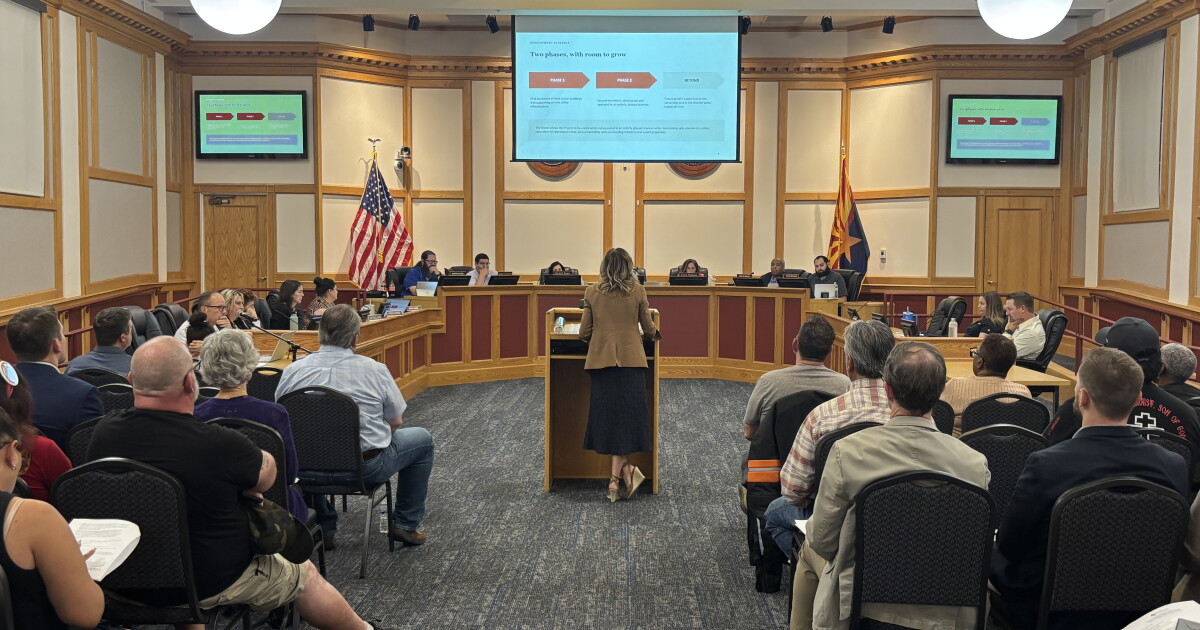
The Casa Grande Planning and Zoning Commission chamber during the October 1, 2026 hearing on the Grande Valley Data Center CUP. About 40 residents attended. (InsideTheValley.com)
Inside the 954-acre site: location, zoning, and the 2,250-acre master plan it belongs to
The 954-acre data center parcel is one piece of a larger 2,250-acre Grande Valley Industrial master-planned area that the city approved the prior year. Think of the data center footprint as roughly 42 percent of a much bigger industrial land strategy LKY has been assembling south of the highway.
The site is zoned Industrial (I-2) and sits about 8 miles from downtown Casa Grande. The data center approval does not cover the full 2,250-acre area — just this parcel within it.
Bloom Energy fuel cells: 1.2 gigawatts and a first for Arizona
The project proposes roughly 1.2 gigawatts of Bloom Energy solid oxide fuel cells for on-site power, plus accessory battery energy storage. It would not draw from the regional electric grid.
Bloom Energy’s solid oxide fuel cells generate electricity through a chemical reaction rather than combustion. They run on natural gas. The project’s proponents say the closed-loop design limits emissions compared to conventional gas-fired generation, but the technology still burns natural gas.
This would be Bloom Energy’s first installation in Arizona.
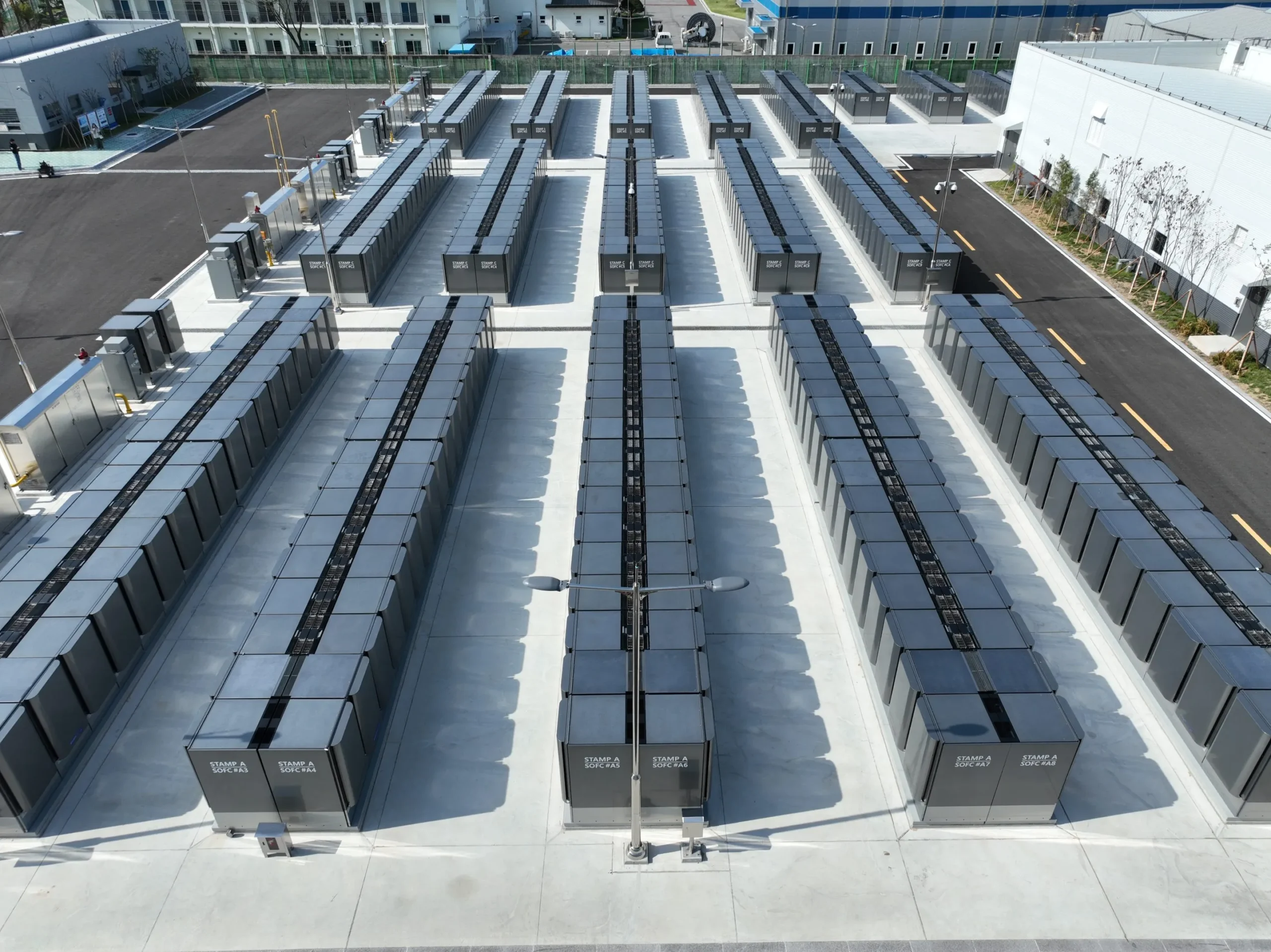
Rows of modular Bloom Energy solid oxide fuel cell units at an industrial facility. The Grande Valley Data Center would install roughly 1.2 gigawatts of this technology — the first such installation in Arizona. (InsideTheValley.com)
No tenant, no builder: what LKY’s buyer search means for the project’s future
A DATABEX project database update reported that LKY Development was looking for a buyer to purchase the broader Grande Valley Industrial site and take over its development. No specific end user or data center operator had been identified at the time of approval.
That combination — no buyer, no tenant, no operator — means the CUP approval is a land-use authorization, not a construction start. The permit clears a regulatory hurdle. It does not mean a data center is coming next year.
If LKY finds a buyer, that buyer would inherit the CUP conditions, including the 300 acre-feet water cap. If no buyer steps forward, the approved permit may simply sit unused.
Casa Grande said yes. Pinal County said no: comparing the two decisions
Less than six weeks before Casa Grande’s 6-1 approval, Pinal County’s Board of Supervisors voted 4-1 on August 26, 2026 to reject the La Osa Energy Center — a large data center and gas-fired power plant proposed near Eloy. More than 60 speakers testified over nearly three hours. The supervisors voted no.
The contrast matters for residents tracking where these projects land. Pinal County, which has jurisdiction over unincorporated land including areas near Eloy, applied its own political and community pressure and stopped a comparable project. Casa Grande, as an incorporated city with its own zoning authority, reached a different outcome — despite visible opposition in the room.
The jurisdictional split is real. A project rejected by the county can still advance within city limits if the city’s commission finds the conditions met. That dynamic will likely repeat as more data center proposals move through the Phoenix Valley’s southern growth corridor. For more on how data center backlash is playing out across the region, see our Arizona data center backlash roundup and the Arizona AG Mayes data center pause analysis.
Appeal window and what comes next
The Planning and Zoning Commission’s vote is the final decision on this CUP unless a party appeals. City Council does not review it automatically. Residents who opposed the project would need to file an appeal through the city’s process to trigger further review.
Beyond that, the project’s actual next step is a commercial one: LKY needs a buyer. Until a developer with a committed tenant acquires the site, the permit authorizes something that no one has yet agreed to build. Watch the DATABEX project database and Casa Grande city notices for any transfer of ownership or updated project filings.