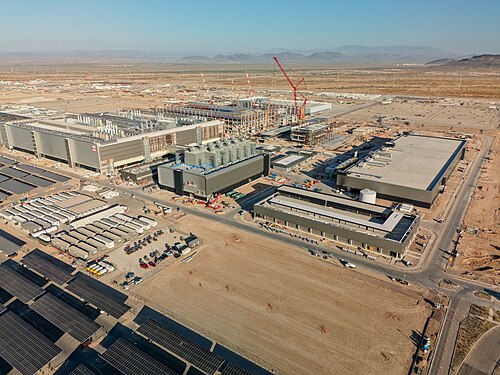
Scottsdale-based De Rito Partners has closed on a 130-acre site inside Halo Vista. It sits at the southwest corner of Interstate 17 and Carefree Highway, next to the TSMC campus in north Phoenix. The plan is an eleven-lot auto mall. Eight of those lots are already committed to dealers. This is also the first large piece of land inside Halo Vista to move from original developer Mack Real Estate Group to an outside buyer.
If you live in the northwest Valley, this changes where you buy your next car
Right now, north Phoenix and the northwest Valley don’t have a true auto row close by. Most residents drive to Scottsdale, Peoria, or the Bell Road corridor to shop for vehicles or get them serviced. The Halo Vista auto mall would put eleven dealerships in a rapidly growing stretch. That area runs from Anthem south toward the TSMC campus — much closer than current options.
That’s a real convenience win, but it won’t happen overnight. The timeline is long. The I-17 and Carefree Highway interchange will see construction activity for years. If you commute through that interchange or live near it, plan for disruption. The upside is tax revenue and jobs that could support more services and amenities across north Phoenix.
The TSMC chip plant is already drawing engineers and construction workers into the area by the tens of thousands. That’s exactly the kind of demand base that makes an auto mall viable this far north on I-17.
What just happened: the $67.4 million land sale explained
Maricopa County property records show De Rito Partners paid $67,376,129 for the site. The deal closed September 23. The parcel measures 125.38 acres, per De Rito’s own project page. It sits at the southwest corner of I-17 and Carefree Highway, also known as SR-74.
This is also a milestone for Halo Vista. It is the first large land parcel to move from Mack Real Estate Group to a third-party buyer inside the 2,300-plus-acre project. Until this sale, Mack had held all of Halo Vista’s developable land itself.
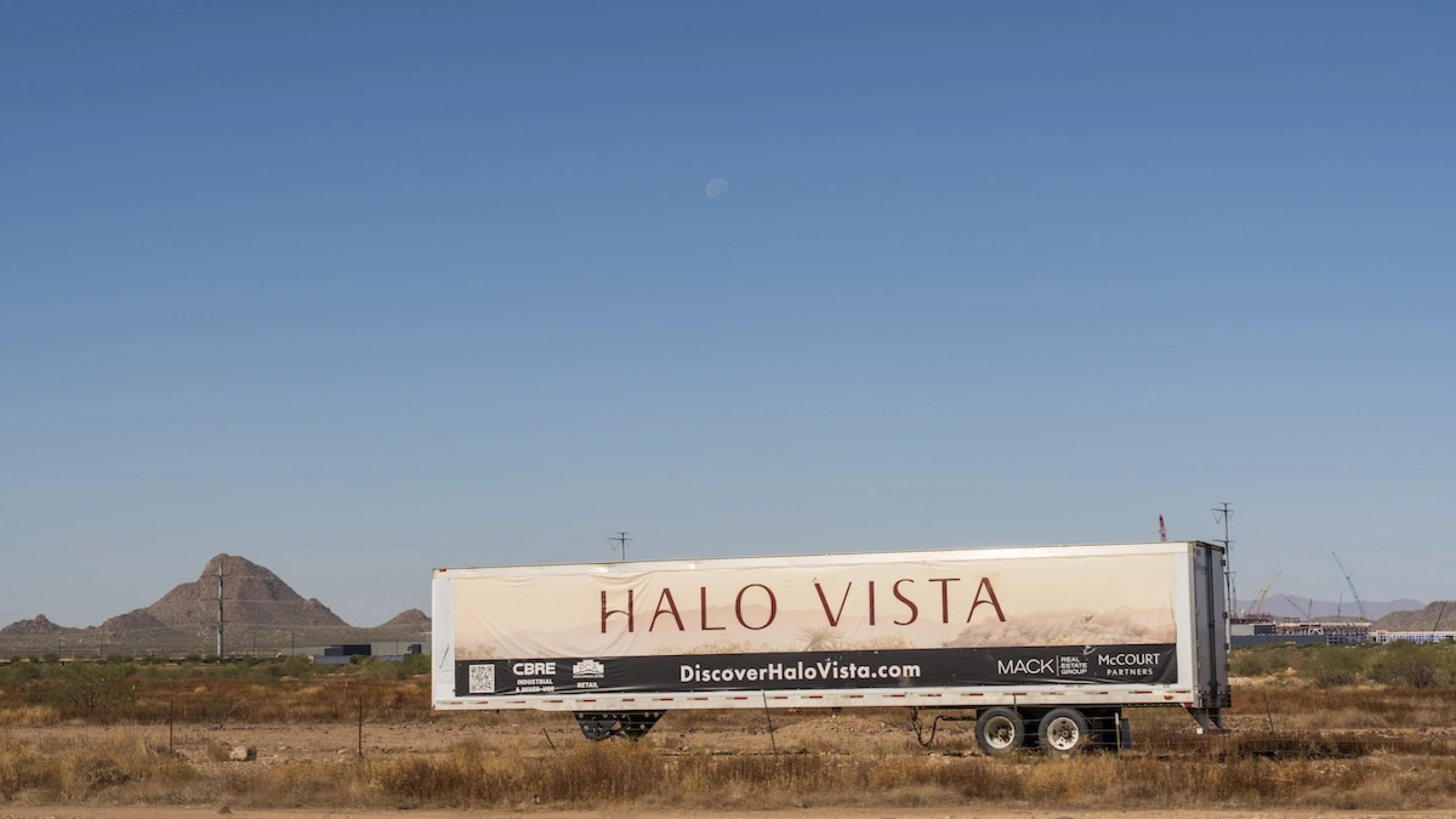
A Halo Vista marketing trailer on site in the north Phoenix desert, branded with CBRE, Mack Real Estate Group, and McCourt Partners. (De Rito Partners / Mack Real Estate Group)
Who is De Rito Partners and why did they get this land?
De Rito Partners is a Scottsdale-based developer. The company says its land acquisition efforts for the Halo Vista auto mall began in 2017 — nearly a decade before this sale closed. That long runway explains why De Rito was positioned to be the buyer when Mack was ready to move the first parcel.
De Rito describes the project as eleven multi-brand dealership opportunities in one of Arizona’s fastest-growing regions. The 125.38-acre site is designed for auto-oriented development. The wave of residents and workers arriving near TSMC made this location a natural fit.
Where exactly is the auto mall and how do you get there?
The site sits at the southwest corner of I-17 and Carefree Highway. That puts it just south of the Anthem area and well north of the Loop 101 corridor.
De Rito’s project page lists five access points: Carefree Highway, Dove Valley Road, 43rd Avenue, 51st Avenue, and Road A. You won’t need to use the I-17 interchange to reach every part of the complex. That flexibility matters once daily traffic builds after opening.
Eleven dealerships, eight already committed: what we know
The auto mall will have eleven separate lots. De Rito says eight are already accounted for as of the closing date. No specific brand names have been publicly confirmed.
The project is confirmed as part of Halo Vista’s first phase. That phase also includes a Costco and a dual-branded Marriott hotel — a Courtyard and Residence Inn together in a five-story building. The auto mall sits alongside those anchors as one of the first uses coming to the Halo Vista site.
From land close to car keys: the full development timeline
De Rito projects about 30 months from the opening of escrow to delivering finished land parcels to individual dealers. After that, dealers need about 18 more months to build their showrooms and open. That adds up to roughly four years before the first dealership is open for business.
Phoenix community and economic development director Christine Mackay addressed timing in testimony to a city subcommittee. She said developers were expected to break ground as early as 2025 for infrastructure and the first phase, including the auto mall.
The Halo Vista context: why this sale is a milestone
Halo Vista is a 2,340-acre mixed-use project in north Phoenix. Mack Real Estate Group is developing it with McCourt Partners, adjacent to TSMC’s roughly 1,100-acre semiconductor campus. The joint venture traces to 2024, when Mack’s affiliate Biscuit Flats Dev LLC won an Arizona State Land Department auction for the site. McCourt Partners then invested in the joint venture. The anticipated total investment is more than $7 billion, with more than 28 million square feet planned.
Mack Real Estate Group and McCourt Partners held a groundbreaking celebration at Halo Vista earlier this year. Remarks came from Mack CEO Richard Mack and McCourt Partners founder Frank McCourt. Phoenix District 1 Councilwoman Ann O’Brien and Arizona Commerce Authority’s Ryan Ruiz also spoke. The De Rito land sale is the first sign that Halo Vista is moving past ceremony and into real transactions with outside developers.
For more on the TSMC corridor, see our guide to TSMC Phoenix water use and north Phoenix impacts and our coverage of the Halo Vista groundbreaking and TSMC corridor development.
The groundbreaking is done — here’s what has to happen before you can test drive anything
The land has sold. The next steps are on De Rito’s side: preparing the 125.38-acre site’s individual parcels and delivering them to committed dealers. Each dealer then builds its own showroom.
No dealership names have been confirmed publicly. Watch for building permit filings with the City of Phoenix as the clearest early signal that a specific brand is moving forward.
Nearby growth is reshaping the broader area too. Lennar paid $60 million for 444 lots near TSMC. The SEMICON West trade show is permanently relocating to Phoenix. Both moves show how seriously the semiconductor corridor is being built out.