
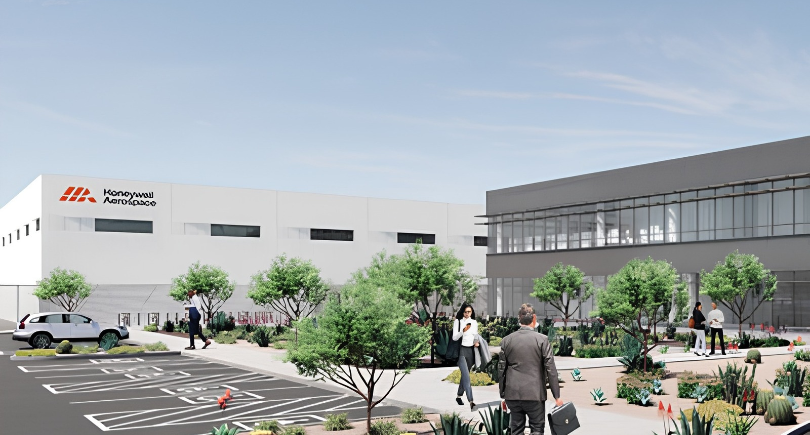
Honeywell Aerospace is building a $500 million, 300,000-square-foot manufacturing facility on its existing Tempe campus near Priest Drive and Warner Road. The plant is expected to open in late 2028 and add about 600 permanent jobs to the East Valley. It is the largest aerospace investment in Tempe’s history, according to Mayor Corey Woods.
Your commute, your job market, and your neighborhood near Priest Drive are all in the picture
If you live or work in southern Tempe, two things will change soon. First, construction. Honeywell plans to break ground in early 2027. That means equipment, workers, and trucks near the Priest Drive and Warner Road campus for most of the next two years. Plan for it on your morning drive.
Second, jobs. About 600 permanent positions are expected once the facility opens. These are advanced manufacturing roles. They typically pay above median wages. During the build phase, more than 1,000 construction jobs will also be created. That is a sustained hiring wave in a part of the Valley that already anchors Arizona’s aerospace sector.
For anyone watching East Valley real estate, sustained high-wage job growth near a specific corridor tends to lift housing demand in adjacent neighborhoods. That does not happen overnight. A facility of this scale has a nearly two-year construction runway before its late-2028 opening. That gives the market time to price it in.
There is no reported zoning dispute, no community opposition, and no competing bid controversy. The city and the company are aligned. The question for residents is not whether it happens, but how to position for it.
What Honeywell Aerospace is building — and why it is happening now
Honeywell announced the expansion on Oct. 28, 2026. The new facility will sit on the company’s existing Tempe campus. It will be built with an integrated digital production system, modular robotics, automated inspection, and digital twins.
The core reason for the build is capacity. Honeywell says its supply chain for complex machined parts is currently constrained. Rather than keep depending on outside suppliers, it is bringing that machining in-house. Two product lines will be manufactured here: Assure actuation systems and Attune vapor cycle cooling subsystems. Both are part of Honeywell’s Control Systems business.
That business has been growing fast. Honeywell Aerospace reported its Q3 2026 earnings on the same day as this announcement. The company had secured more than $20 billion in new wins year-to-date, measured by estimated lifetime value. Nearly $15 billion of that came from new Control Systems program wins alone. The company said the Tempe facility will add capacity, lean manufacturing, and automation. It will also strengthen supply chain resilience for current production, recent wins, and next-generation platforms.
The expansion also supports a supplier framework agreement Honeywell Aerospace signed with the Department of War on March 25, 2026. That agreement included a separate $500 million multi-year investment commitment to upgrade Honeywell’s own production capacity. That commitment is distinct from the $500 million Tempe facility announced in October 2026.
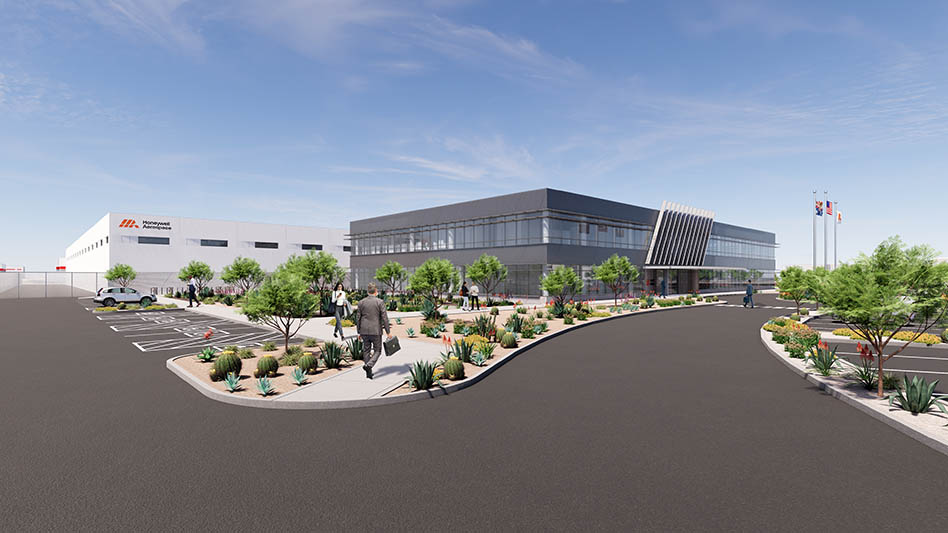
Rendering of the planned Honeywell Aerospace manufacturing campus in Tempe, with the Honeywell Aerospace logo visible on the warehouse structure at rear. (Honeywell Aerospace)
The HONA spin-off: why this investment is possible in 2026
Honeywell Aerospace did not exist as a standalone company until this year. On June 29, 2026, Honeywell Technologies distributed shares of Honeywell Aerospace stock. Shareholders received one Honeywell Aerospace share for every two Honeywell Technologies shares held as of the record date. That distribution totaled 316,939,750 shares. Honeywell Aerospace began trading on Nasdaq that same day under the ticker HONA.
The spin-off matters here because the company says independence is what makes investments like this one possible. As a pure-play aerospace and defense company, HONA can direct capital toward aerospace manufacturing without competing against other business units for resources. At the time of the spin-off, Honeywell Aerospace reported more than $17 billion in annual revenue for 2025. It launched with about 36,000 employees across more than 90 global facilities.
The Tempe factory is one of the first major capital commitments the newly independent company has announced.
Arizona’s second-largest defense contractor just got bigger
Honeywell Aerospace is already Arizona’s second-largest defense contractor. It employs nearly 9,000 people across seven offices and manufacturing plants in the Phoenix metro. The Tempe expansion adds to that footprint directly.
This is also the second major Arizona manufacturing announcement from Honeywell in a single year. On April 20, 2026, the company announced it would build F124-GA-200 jet engines at its Phoenix campus. Those engines will power the Beechcraft M-346N for the U.S. Navy’s Undergraduate Jet Training System program. More than 400 engines are expected over 13 years starting in 2027.
Honeywell Aerospace President and CEO Jim Currier said the Tempe expansion “reinforces our commitment to this great state, our employees and the Arizona workforce.” Mayor Woods called it “the largest aerospace investment in Tempe’s history.”
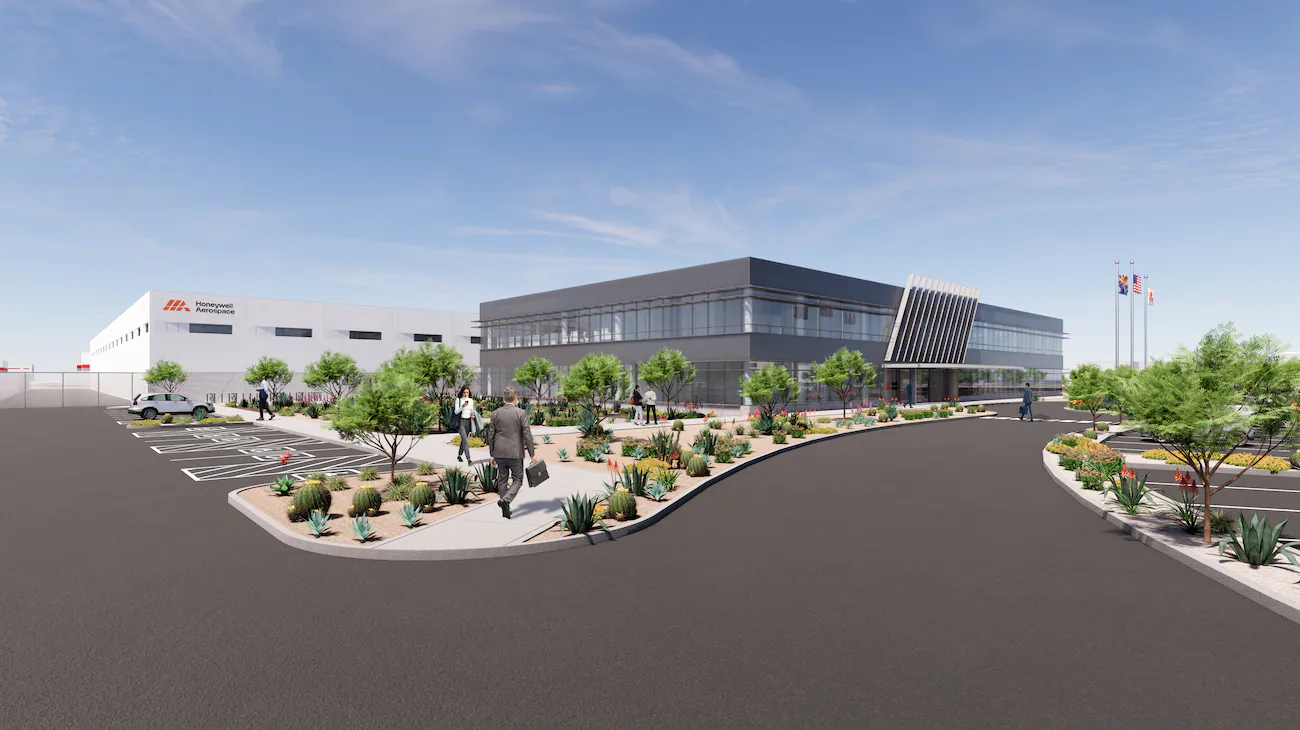
A second rendering of the Honeywell Aerospace Tempe campus expansion, showing the office and manufacturing buildings with desert landscaping and flags. (Honeywell Aerospace)
Groundbreaking early 2027, opening late 2028: the full timeline
Here is where the schedule stands today, Nov. 4, 2026:
- Oct. 28, 2026: Expansion announced alongside Q3 2026 earnings.
- Early 2027: Groundbreaking planned on the existing Tempe campus near Priest Drive and Warner Road.
- Late 2028: Facility expected to open and begin operations.
No competing development or regulatory hurdle has been reported. The site is on Honeywell’s existing campus. That removes the most common sources of delay — land acquisition and zoning. Expect construction activity in the area from early 2027 through most of 2028.
Large-scale manufacturing drives local housing and infrastructure demand. We cover two related stories worth reading. See our piece on Intel Fab 62 in Chandler. Also see our guide to TSMC’s Phoenix water impact. Tempe is also seeing broader commercial growth along Mill Avenue and at Tempe Marketplace.